

Notes on Writing
I’ve been reading. I’m always reading. The younger poets lately, the ones still finding the knife. And I keep encountering the same confusion – this reaching for grotesque as if grotesque were the same thing as brutal. As if piling dark imagery like cordwood could make the reader bleed. Festering womb. Gutted cathedral. Skinned hymnal. Stacked and stacked. More and more. As if enough darkness in a row becomes a poem.
It doesn’t become a poem. It becomes a Halloween store.
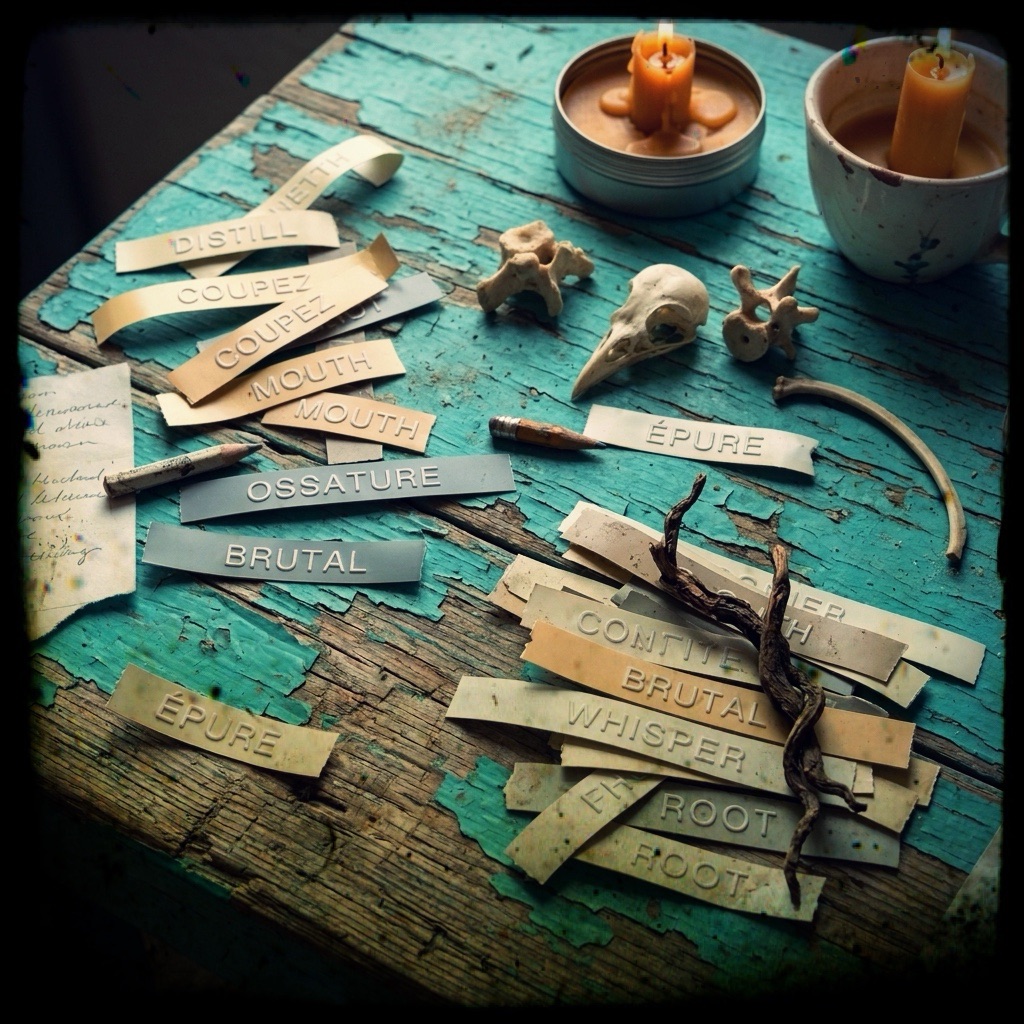
I lay these on the rough table. I look at them. I look at them the way I look at a root I haven’t identified yet – what’s the medicine, what’s the filler, what’s the part that will make you sick if you don’t know what you’re holding.
What I find, almost every time, is a poet who mistook accumulation for escalation. Who stacked twenty dark images where one would have shattered the room. Twenty is easy. Twenty is a list. One true image costs you something. One image, the right one, the one pulled from the body and not from the imagination, changes the temperature of the room. That’s brutal. Everything else is decoration.
The word choices. Let me lay a few on the table.
You’re writing about death. You’re reaching for the darkest thing your hand can find. And you land on drooling. Drooling. That’s your uncle asleep on the couch after Thanksgiving. That’s a baby on a teething ring. You just dressed your corpse in a bib. You didn’t mean to, but the word did it for you because you weren’t listening. You were looking at the word on the page and thinking it sounded dark enough. A poem doesn’t live on the page. A poem lives in the mouth. And if the word conjures the wrong body, the wrong room, you’ve pulled the reader out of the poem so gently they don’t even know they’ve left. They just stopped feeling. And they won’t come back.
Splattered. That’s a Jackson Pollock documentary. That’s a tomato dropped on a kitchen floor. You wanted carnage and you got a cooking accident.
Oozing. That’s an infected cut on a child’s knee. That’s cheese on nachos. Every body in the room just thought about nachos. Your poem about death now smells like a sports bar.
Rotting carcass. Two words that have been in so many poems and so many horror films they arrive pre-numbed. Dead before they reach the page. A carcass that rotted so many times in so many mouths there’s nothing left of it. You wanted the reader to smell death and instead they smelled a word that’s been used so many times it doesn’t smell like anything anymore.
This is what grotesque does. It reaches for the most obvious dark thing and it doesn’t listen to what the word actually does in the mouth, in the ear, in the reader’s private library of associations. Every word carries a suitcase. You have to know what’s in it before you use it.
And cleverness. The compound images. Cyanide baptism. Slaughterhouse hymn. Cannibal carousel. I understand the reach. The alliteration. The surprise. But what the reader does with clever is nod. A small admiration from a safe distance. That’s a good phrase. And then they’re still standing. Still comfortable. Still intact. Nobody’s on the floor. If you’re writing about death and the reader is still on their feet, you made a poster. You didn’t make a poem.
Grotesque stacks. Brutal distills.
Grotesque performs from a distance. Brutal stands inside the burning house and tells you what it smells like in there because no one else will.
Grotesque asks you to look. Brutal won’t let you look away.
I’m not telling anyone how to write. I’ve never been interested in that. These are my notes. This is my table. I lay things out and look at them with my hands and my mouth. You can sit here or you can walk past. Makes no difference to the table.
But I’ll say this because I know it in my body, in my practice, in every poem that stripped me on its way out –
The most violent thing a poem can do is whisper.
Quiet will always be more brutal than loud. In every language. In every mouth that’s ever tried to say the unsayable and meant it.


 Pretty Thunder Poetry
Leave a reply to Anna Cancel reply